Turning a Breech Baby with Moxibustion: A Gentle At-Home Guide
When your baby settles into a good position in the pelvis, labour tends to start and progress more smoothly, and birth is often calmer and more comfortable. If a caesarean ends up being the safest path, a well-positioned baby can help that go more smoothly too.
Moxibustion is a gentle, low-cost technique you can do at home to support this. I find it works even better alongside a course of acupuncture.
Why babies end up in a less-than-ideal position
Sometimes there’s a clear physical reason, like the shape of the uterus, where the cord or placenta sits, or having too much or too little amniotic fluid. Often there’s no obvious cause at all. From a Chinese Medicine perspective, I also look at things like blood flow, tension through the hips and lower back, and how well energy is moving. These are the patterns I treat to give your baby the best chance of settling head down.
What moxibustion does
For centuries, moxibustion has been used not to force a baby to turn, but to improve the space available. If it’s safe for your baby to move, that gives them the room to find their best position for birth.
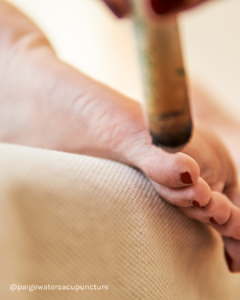
The technique uses warmth from a moxa stick to stimulate acupuncture point BL 67, on the outer corner of your little toe. You can use it for breech or any other position that isn’t head down and facing your spine.
Acupuncture is about balance, not force. Moxibustion works with your body, so it isn’t about pushing your baby somewhere they aren’t ready to go. If it doesn’t shift things, you’ve still spent 20 minutes a day slowing down and doing something kind for yourself, and that has its own benefits.
Before you start
Please check with your midwife or doctor before trying moxibustion, especially if you have any pregnancy complications. The research supports starting from 34 weeks. If your baby is found to be breech later than that, it’s still worth trying.
What you’ll need
- a moxa stick. I recommend smokeless moxa, which gives off far less smoke and smell than traditional moxa. Get in touch if you’d like to buy one.
- a small glass or ceramic bowl, half filled with water
- a candle
- an old towel, because the moxa stick drops ash
- a comfortable chair or lounge in a well-ventilated spot, away from pets and distractions
A note on ventilation: even smokeless moxa gives off a little smoke, so open a window or door while you work. Traditional moxa is much smokier and can set off smoke alarms, so if you’re using it, sit near an open window or outside on a sheltered verandah.
How to do it
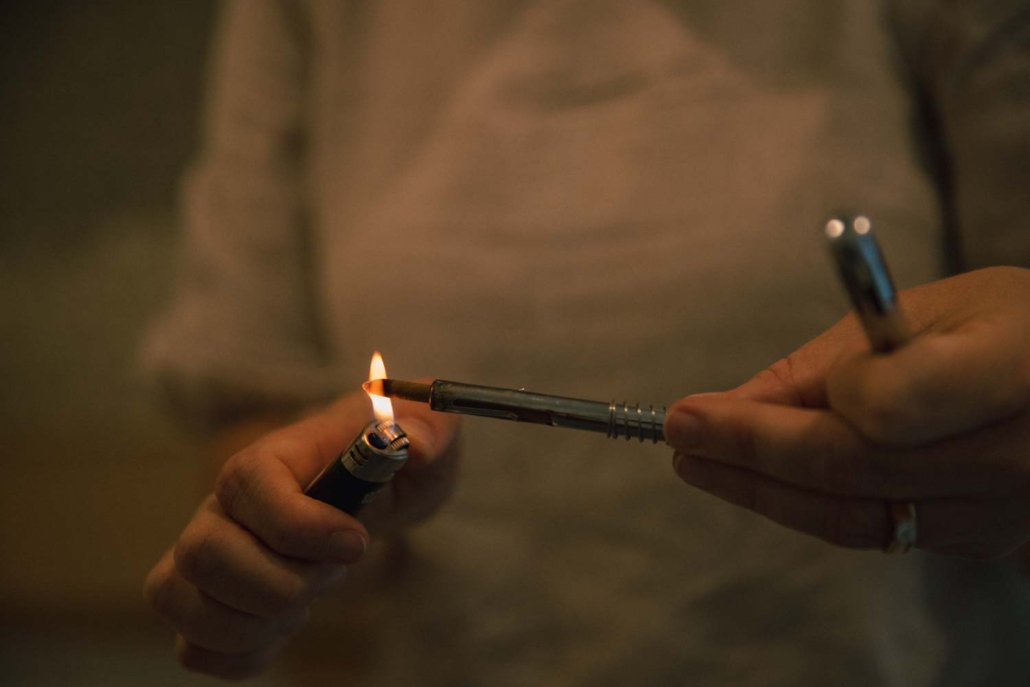
- Light the moxa stick. Hold the end over the candle until the whole tip is glowing. Smokeless moxa takes a little longer, often a few minutes the first time, so be patient.
- Get comfortable. Sit with your ankle drawn up beside you so you can easily reach your little toe (see picture).
- Hold the warmth near your toe. Keep the glowing end about 1cm from the outer corner of your little toe (see picture). Tap the ash off on the side of the bowl as you go.
- Pulse the heat. When your toe starts to feel too warm, move the stick away for a couple of seconds, then bring it back. Keep doing this for 15–20 minutes on each foot.
- Repeat daily for 10–14 days. Then check in with your midwife to confirm your baby’s position. If baby turns before then, you can stop.
- Put it out safely. Place the lit end in the bowl of water, or in sand or rice. Smokeless moxa holds heat for a long time, so check it a few minutes later to make sure it’s fully out before you put it away. Let it dry in the sun, and if it hasn’t dried by next time, light the other end.
Always store your moxa stick out of reach of children and pets.
If you have any questions, or you’d like to add acupuncture to support your baby’s positioning, please get in touch via email hello@paigewatersacupuncture.com.au